Asla bir daha. Kalbin inlemesi kırılınca.
Ölüme hükmeden hakim. Asla bir daha.
Fütursuz dalga kasvetli kayalara çarptığında artık
yalıyarda fırıl fırıl dönenen martıların bastığı çığlık.
Asla bir daha, zalimaneydi, kız da bunu sevmişti.
Mezar kadar amansızca, mezar oydu zaten belki.
Bu sözle gömülürdü insanların umut ve hayalleri.
Geçmiş hatırı belirtmek geleceği burultmak içindi.
Eskiden sevilen kişi veya kişiler nerede olsa gerek?
Ummanlar ötesinde, Asla bir daha görüşülmeyecek.
Oynandı oyunlar, Asla bir daha raksedilmeyecek.
Manidar gülüşlerle artık eller tutuşuvermeyecek.
Gece gölge altında gölden nehire çekilen kürek…
İlk buluşacağınız gün umutla zil sesini beklemek…
Hepsi geçti gitti, hepsi oldu bitti. Asla bir daha.
Her gece nehrin süzülüşü sürer sürmesine ama…
Başka ne zaman solgun Ay onlara şahitlik edecek?
Ne zaman frenlenecek Sera etkisi ve açacak çiçek?
Asla bir daha olmaz, katiyen bir daha olmaz, olamaz
Ve bu kız da kuzgunlardan başka hiçbir söz duyamaz:
“Söylendi kuzgun, Asla bir daha.”
En hüzünç satırdı İngiliz nazmında
James Matthew Barrie, The Greenwood Hat, s. 126 (sayfanın en altında)
Türkçesi: Işık Barış Fidaner
>>> Robot şarkı 🤖🌈 <<<
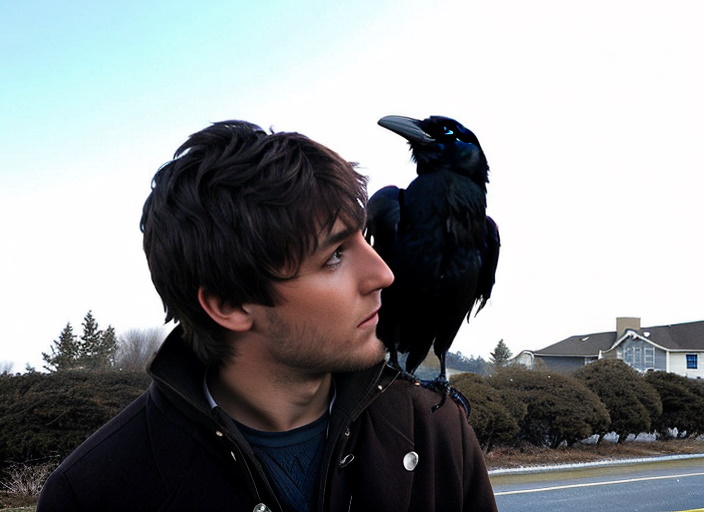
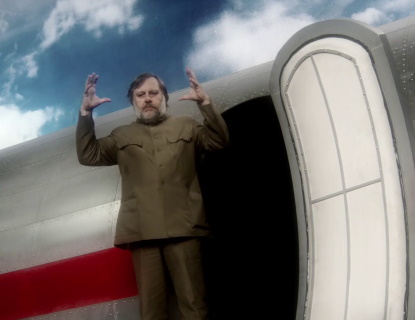
İmge üretiminde bir fotoğraf suni istihbarat (AI) sistemi GetIMG‘den geçirildi.
Bkz “Kuzgun” Edgar Allan Poe, “Peter Pan çocuklarla Hiçpekora yolunda (Neveryland)” James Matthew Barrie, “Susma Haykır Periler Vardır!” Peter Pan, “Sunî istihbaratla öğretilen bilgisayar grafiği canlandırmasına bir tepki” Hayao Miyazaki, “korkma sönmez çatma kurban!”
CHAPTER XI
“THE SADDEST WORD”—DARK PASSAGES IN ANON’S HISTORY
“I was in the Scotch express on my way to London, and I think it was at Carlisle that five of them boarded my compartment, all husband-high. When their packages had been disposed of and they were comfortably settled in their seats they turned their eyes on me and gave their verdict in the deaf-and-dumb alphabet, which unfortunately I understand. It spelt out the words ‘Quite harmless,’ and they then disregarded me for the rest of the journey. They talked openly of the most intimate things as if I were far away in the guard’s van. It is a treatment I am used to, but never perhaps have I been so blotted out, I who know that with another face I could be quite harmful.
They were bound, as their conversation showed, for a wedding where at least two of them were to be bridesmaids, and had almost as many topics as chocolates, but the one over which they lingered most lovingly was the Saddest Word. A tall poetical-looking girl thought that the saddest word was Nevermore. She was the loveliest of my scorners, her cheeks of the most delicate carmine and her eyes were like lakes. The fingers with which she had spelt out my doom betokened grace and breeding, while her voice, capable of the most varied modulations, now soft and tender, now deep and mellow, and again clear and bell-like, was of the timbre to stir a man who was not harmless to his innermost soul. Nevermore. The word in her opinion sounded like the wail of a broken heart. It was a judge passing sentence of death. Nevermore. That was what the relentless waves said as they dashed against the sullen rocks, and the seagulls eddying round the cliffs took up the shrill response. What she specially liked about Nevermore was its cruelty. It was as cruel as the grave. Was it not the grave itself, the grave of human hopes and aspiration? It recalled the past only to make the future more bitter. The loved ones, or the loved one of the past, where were they, where was he? Far away across the seas; we should meet him Nevermore. The dances we have had. Ah, the dances we shall have Nevermore. The smiles that were. The warm clasp of the hand that seemed so trivial, that meant so much. The nights on the river, when the boat glided down, shadow-like. The day when first they met and all seemed merry as a marriage bell. All, all are gone. Nevermore. The river glides on; but when shall they see it together again, they and the pale moon? Still the conservatory stands; but is it the conservatory of the days of yore? Ah, Nevermore, Nevermore. She could not look upon a raven now without fancying it croaking forth that doleful solemn word. ‘Quoth the raven, Nevermore,’ was the saddest line in English poetry.
Nevermore did not seem so inexpressibly mournful as simply ‘Never’ to a second girl, who was undoubtedly the fairest in the compartment and was sitting on my newspaper. It is no disparagement to the others to say that she shone among them like the moon among stars. Yet were the sun a more fitting emblem, for she seemed a ray of sunshine rather than a being of flesh and blood. She was of a small form of the most enchanting roundness, and her noble head stood on a neck white as the untrodden snow. Her golden hair (or coal-black hair, for at times I got a little confused) escaped from its single band of ribbon, and fell in rich profusion over her shapely shoulders, caressing her delicate shell-like ears, and ever and anon lightly kissing the red pouting lips that men with some harm in them would have gladly done deeds of derring-do to win. Her melting eyes seemed ever on the point of glistening with a tear; and as she spoke falteringly, dreamily, she slowly picked a bun to pieces to get at the currants. Never was sadder than Nevermore because it did not even imply the pleasures of memory. Nevermore meant that though you might now be old and grey there had been moments of happiness to which you could look fondly back. They were gone, but they had been. No such solace could be got from Never. The lover’s glance, the hand-pressure, the moments in which one lives a lifetime; it was sad indeed to think that they would be no more, but sadder to think that they had never been. Nevermore was a sentence for the future, Never for the past and the future too. Saddest of all, Never meant that you knew what you had missed, what you must go on missing to the end. The most terrible line in English poetry was not ‘Quoth the raven, Nevermore,’ but,
Never—for ever; for ever—Never.
The bells tolled it when the grave was filling, and the aged hills sent back the mournful words. The time to appreciate their significance was in autumn in the woods when all the twigs were bare and the naked trees shivered in the cold. Wandering through the dead and rustling leaves (or eating buns in a train), she loved to murmur, ‘Never, for ever; for ever, Never.’
The others might be pretty; but the third speaker was a queen among her sex, majestic, stately, superb. Her eyes were black as death, their lashes of the same hue. Eyes wonderful, fatal not only to others, but to herself. Two dark arches marked the low brow, and the creamy skin had the blush that is at once the painter’s admiration and his despair; in tint it looked like a magnolia petal laid on a rose-leaf. Her white firm hands were plump and dimpled, with lissom fingers and cameo nails that might dig deep on provocation into the kind of man who was worth while, namely, any man except a harmless one. She spoke with a seductive voice that vibrated like sweet music through the compartment. To her, sadder far than any word was the tragic story told in the phrase It Might Have Been. Nevermore dealt with the inevitable. However bitter Never might be, not yours was the blame. Fate said that what was would be Nevermore; you had no voice in the matter. With It Might Have Been all was different. It implies fault on your part; and what so bitter in this vale of tears as the consciousness that you suffer for your own error, your own blindness? It is sackcloth and ashes now, and It Might Have Been bridal garments. It Might Have Been. With these words you are back again at the honeysuckled gate of your youth. Ah, how well you remember it, with its broken spars and the catch that clicked. He came. He was impatient, perhaps; but you, you were coy, and you parted to meet no more. That was the turning-point of your life. You did not realize it then. You know it now. And how easily It Might Have Been. Or it was at the yeomanry ball, and you sat on the stairs with Another. You longed to be with Him, for you had read aright from his eyes the tale he longed to tell; but though your hand would have thrilled to his touch you were mad and you sat on the stairs with Another. Mad, mad. And so he turned on his heel and left you, and the light went out of your life. It Might Have Been.
There is an attraction in some faces beyond all mere physical charm. A girl who thought there was most sadness in the simple words A Faded Flower had an ethereal look that the others lacked. A harmful man would perhaps have admired the others more, but he would have chosen the seat beside her. What was it about her that gave her this subtle fascination? At times you would have said (if you had been sufficiently harmful to be worth listening to) that she was absolutely plain, and yet her face haunted you like a painting by the old Masters. Was it that there was a history in that face, that she was one who had already lived and suffered? She regretted that they had not bought chocolate cakes instead of drops, and it was because A Faded Flower was pathetic rather than tragic that she liked it best. A flower was the emblem of happiness; for it was short-lived. It was here to-day and gone to-morrow. Yet not gone; for the withered stem remained in your hand. The flower was the loved one’s gift far more than glittering jewels, for love was a thing that could not be bought, and a flower cost nothing more than a broken heart. If one could write the history of all the faded flowers that have ever been preserved, it would be a history of the heart since the days of Eve.
The fifth girl was such a one as it is the glory of English homes to grow. There is only one description of her: she was an English girl. Of a blooming complexion and elastic step, hers was the beauty of rosy health. She had been obviously a good daughter, and you could not look at her without feeling that she would make a good wife if you were sufficiently harmful to attract her. No other girl is to be mentioned in the same breath with such a one. She thought there was something strangely sad in the words She Never Told Her Love. Think of the unutterable grief of seeing him day by day as the years roll on, and knowing that he thinks she is without a heart. Ah, fate is sometimes hard. He will never know that her love for him is even as his for her.
This girl, who had more buns than any two of the others, specially infuriated me, and it was while she was still prating, as they had all been doing, of the kind of bounder she preferred (for that is what it amounted to) that I began ostentatiously to converse with myself in the deaf-and-dumb alphabet. Having thus got their scared attention at last, I joined briefly in their discussion. ‘Ladies,’ I said in deaf-and-dumb, ‘the saddest words a broken-hearted young man can have applied to him on his journey to London to seek his fortune is that he is “quite harmless.” ’ I then bowed (if the Scotch can bow) and withdrew harmlessly to another compartment.”














Geri bildirim: Dunganga — derleme | YERSİZ ŞEYLER
Geri bildirim: Elifbe — derleme | YERSİZ ŞEYLER
Geri bildirim: Suni Muhaberat üç buçuk: Hele bir mayış! | YERSİZ ŞEYLER
Geri bildirim: Muhaberat — özel sayfa | YERSİZ ŞEYLER
Geri bildirim: Yaz ula buni da! Laz ula bu nida! (La isla bonita) ~ Madonna | YERSİZ ŞEYLER
Geri bildirim: Nümerik Esintiler 🤖🎸 | YERSİZ ŞEYLER
Geri bildirim: Nümerik Esintiler 21: Yapay Zeka Radyo Programı 🤖📻💌 | YERSİZ ŞEYLER